Why Stars Seem to Shift Across the Night
Why stars seem to shift across the night comes down to Earth’s rotation. Learn what moves, what stays fixed, and how to choose a simple way to watch.
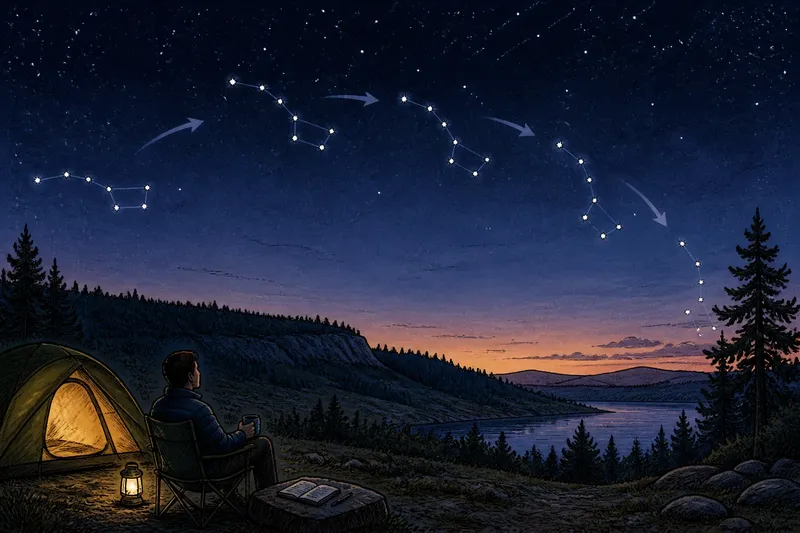
You spot a bright star above a neighbour’s roof, go inside for supper, then find it nearer the edge of the roof when you look again. Why stars seem to shift across the night is a question with a practical answer: Earth is turning, carrying you and the landscape beneath a sky that appears to move in the opposite direction.
You can watch that motion in several ways. A fixed landmark gives you a quick visual comparison; a constellation makes the change easier to recognise; and a simple observing record helps when you want to compare one evening with another. Choose according to how much time and attention you want to give the sky.
Earth’s rotation makes stars appear to travel west
Earth spins from west to east. As it turns, stars appear to cross the sky from east to west, much as scenery seems to slide backwards when you travel forwards in a train. The train analogy has limits: the stars are not attached to a nearby backdrop, and their enormous distances make their positions against one another seem steady over an evening.
Look east and you may see stars rising above the horizon. Across the night they appear higher, then move towards the western horizon. A star already in the west continues towards the horizon and eventually disappears from view. The timing and path depend on where you are, which direction you face, and the time of year.
The motion is apparent, not a nightly rush of nearby stars around Earth. Their positions relative to one another change too slowly to be obvious during an ordinary evening. What changes noticeably is where the whole pattern sits above local features such as rooftops, hills or a line of trees.
Choose a watching method that fits your evening
A landmark comparison is the easiest option. It suits a casual look from a garden, campsite or safe public viewpoint, especially if you do not know constellation names. Pick one star and note its position relative to something stationary on the horizon. Return to the same place and face the same direction later; the changed alignment makes the apparent motion clear.
A constellation is better if you want to follow a broader pattern. Choose one that is easy to recognise from your location and season, then notice how its shape tilts or shifts relative to the horizon as the evening goes on. This approach suits a longer outing or a family explanation because several stars move together in the view.
A short observing record is useful if you enjoy making careful comparisons or want to revisit the same patch of sky on another evening. Write down the date, approximate time, facing direction, a recognisable landmark and the star or constellation you watched. A phone’s compass can help you orient yourself, but dim its screen or put it away between notes so your eyes can remain adjusted to the dark.
Say you are standing at a campsite with a low ridge to the west. You note that a recognisable constellation is above the ridge’s left-hand slope, then check again after supper from the same spot and facing direction. It now appears closer to the ridge’s centre. That visible change is enough to follow the sky’s apparent motion; the notes simply make the comparison easier to repeat.
For a brief, no-equipment look, choose the landmark method. For a more memorable view, follow a constellation. Choose a record if you want to compare positions across evenings rather than rely on memory. There is no need to turn the observation into a technical exercise unless that is part of the fun.
What changes with direction, season and location?
Where you face affects the shape of the apparent path. Looking east, you can watch stars rise; looking west, you can follow them towards setting. Looking south in many Northern Hemisphere locations, stars generally cross the sky in arcs. Near the north celestial pole, some stars appear to circle around a point in the sky rather than rise and set during the night. The view differs in the Southern Hemisphere, where the corresponding apparent centre is near the south celestial pole.
Your latitude changes which stars are visible and how high they travel above the horizon. Season also matters: Earth’s journey around the Sun changes which part of the distant sky is visible at night. So a constellation that appears in one evening’s view may not be in the same place—or visible at all—at the same clock time in another part of the year.
These differences do not contradict Earth’s rotation. Rotation explains the steady apparent drift during an evening. Your location and the season shape the route and the set of stars available to observe. Keep those ideas separate when comparing a view from home with one seen while travelling.
How can you tell what is moving?
Do stars move or does Earth turn?
During an evening, Earth’s rotation accounts for the broad east-to-west drift you see. Stars do move through space, but that motion is not what makes a whole constellation shift against a rooftop over a short interval.
Why do some stars seem to stay in one place?
A star near a celestial pole can appear to circle around that point, so it may not rise and set in the way a star farther away from it does. From your viewpoint, its path can look like a slow turn around the centre of the sky’s apparent rotation.
Will a constellation look the same all year?
Its stars keep a recognisable pattern, but the constellation’s place and visibility at a given evening hour change with the seasons. The view also depends on your location and whether buildings, trees or terrain block the horizon.
Can I use a phone to follow the motion?
A sky-map app can help identify a star pattern, while a compass can help you face the same direction for a later comparison. Treat the display as a reference rather than the observation itself: look up, pick a fixed landmark, and check that the app is set for your location and time.
Make the comparison fair and comfortable
For a useful comparison, stay in one spot and keep your facing direction consistent. Choose a landmark that will not itself move, such as a roofline or ridge, rather than a passing vehicle or a tree branch shifting in the wind. If clouds interrupt your view, wait for a clear patch instead of treating a changed cloud edge as a new sky position.
Give your eyes time to adjust to the dark and avoid shining a bright torch towards other observers. If you are watching from a roadside, cliff edge or unfamiliar place, choose a safe area away from traffic and hazards before looking up. A clear view is not worth an uncertain footing.
Why stars seem to shift across the night becomes easiest to grasp when you compare the same star with the same unmoving feature. Pick the simplest method that suits your evening, note where you are facing, and look again later. The sky’s apparent motion then becomes something you can see for yourself, not just an explanation to remember.