The Earthrise Image and the Viewpoint That Made It Possible
Read the Earthrise image through its viewpoint: trace the lunar horizon, camera position and framing to see how distance changes what the scene means.
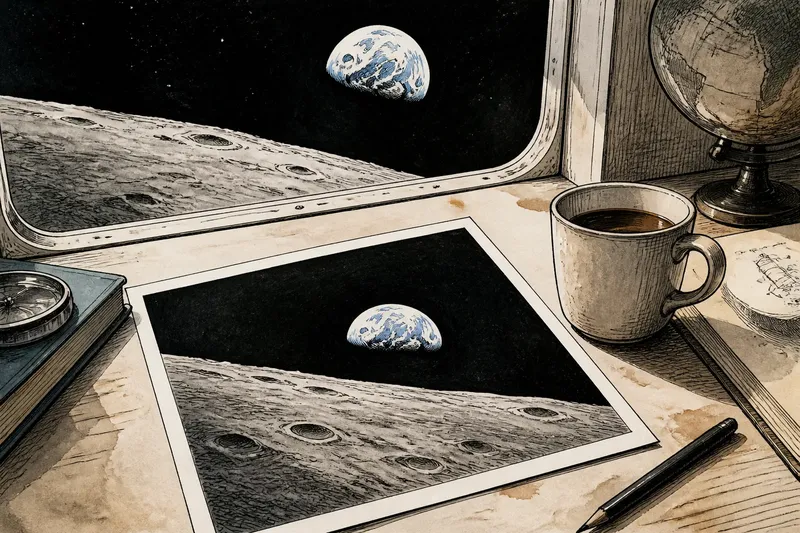
A print of the Earthrise image lies beside a cup on the table, and the lunar edge catches your eye before the planet does. To read the Earthrise image carefully, start with that curved horizon, then ask where the camera was and what the photograph leaves outside its frame.
The well-known Apollo 8 Earthrise photograph was made by astronaut William Anders during the spacecraft’s lunar orbit. Its viewpoint came from Apollo 8, not from a person standing on the Moon. Keeping that distinction in mind lets you separate what the photograph shows from the story its composition suggests.
Start with the lunar horizon
Follow the Moon’s curved edge before looking at Earth. The horizon marks the boundary between the visible lunar surface and the darkness beyond it, but it does not resemble a familiar landscape viewed from standing height. There are no trees, buildings or sea to supply everyday scale.
The curve establishes the Moon as the foreground and gives your eye a route into the scene. Earth appears beyond the lunar edge, not alone against space. Like a table edge that helps you judge where an object sits, the horizon anchors the composition without turning it into a map.
Locate Earth and separate observation from interpretation
Earth is visible above the lunar horizon, bright against the dark background. The arrangement can look like a planet rising, but “Earthrise” is a name for the view, not proof that the scene is equivalent to sunrise from a fixed place on the lunar surface.
Keep two kinds of statement apart. “Earth appears above the Moon’s curved edge” describes something visible in the photograph. “Earth looks like a shared home” describes a response to it. Both can be useful, provided an interpretation is not mistaken for a fact recorded by the camera.
Notice where your eye goes first. If it lands on Earth, consider how much of the frame the planet occupies; if it follows the lunar edge, the Moon may seem to dominate. The image remains the same, while your attention gives different features more weight.
Understand the camera’s position
The camera’s viewpoint was aboard Apollo 8 as it travelled around the Moon. It was neither a view from lunar ground nor a view from an imaginary observer floating without a location. The spacecraft’s position and the camera’s orientation shaped which part of the lunar edge and Earth entered the frame.
This matters because a photograph records a particular arrangement, not a permanent view available from every spot. Shift the viewpoint and Earth’s position relative to the Moon would appear different. A still image can invite a story of movement, but it does not show the full route or motion by itself.
Say you have a printed copy and turn it so the lunar edge runs along the bottom. You may read Earth as emerging over the Moon. Turn the page sideways, and the same forms can feel more like Earth hanging beside the edge. The shapes have not changed; the orientation has changed the way your eye reads their relationship.
Read the frame’s limits
The photograph’s borders include some parts of the scene and exclude others. They do not show every direction around the spacecraft, the full path of its movement or the people looking at the image later. The frame is a limit on what the photograph can tell you, not just a border around the subject.
There is no person or everyday object in the picture to make the distance easy to judge. Earth is recognisable, but familiar reference points are absent. That can make the planet feel remote, or prompt viewers to connect it with home; the image leaves room for both readings.
Dark space is part of the composition. It separates Earth from the lunar foreground and makes the bright planet stand out. Whether that contrast suggests isolation, belonging or something else depends partly on the viewer’s own associations.
Use the Earthrise image without treating it as a map
The Earthrise image does not provide a complete diagram of the route between Earth and the Moon. It cannot, by itself, tell you the spacecraft’s full direction of travel, how quickly the view changed or what another camera position would show.
Nor does the top edge of a photograph automatically mean “north” as it might on a map. A photograph’s orientation affects how the scene reads, but it does not turn the image into geographic instructions. Use it to examine a viewpoint and composition, not to infer details the frame does not contain.
- Check the lunar edge: if its curve is clear, use it as the foreground boundary; if a crop hides it, avoid making claims about the horizon’s shape.
- Check Earth’s position: if the planet sits above the edge, describe that visible arrangement; if the reproduction crops Earth, do not infer the missing portion.
- Check the frame’s orientation: if the top and bottom are apparent, note how they guide your eye; if the image is rotated, compare the scene before assigning “above” or “below”.
- Check the caption: if it identifies the Apollo 8 context, use that as historical context; if no caption is supplied, describe the visible scene without guessing the camera’s location.
- Check the crop: if the lunar surface and surrounding darkness remain visible, discuss their contrast; if the crop removes either, limit your reading to what remains.
- Check your wording: if a sentence describes a visible feature, present it as observation; if it assigns emotion or meaning, frame it as an interpretation and give the visual detail that prompted it.
What does the viewpoint help you understand?
Why does Earth seem to rise above the Moon?
The lunar edge provides a foreground boundary, with Earth visible beyond it. That arrangement invites the familiar idea of rising, even though the photograph records a view from a spacecraft rather than a conventional sunrise scene.
Does the photograph show Earth as fragile?
Some viewers may read the small, bright planet against darkness as vulnerable or precious. That is an interpretation shaped by scale, contrast and personal ideas about home, not a single message established by the image.
Would a different camera position change the scene?
Yes: it could change which body appears in the foreground, where Earth sits in relation to the horizon and what the frame excludes. Those changes would guide the viewer’s attention differently.
Does the photograph show the whole event?
No still photograph contains every movement, surrounding view or experience of the people aboard the spacecraft. It preserves one visual moment; historical context and captions can add information beyond what appears in the frame.
Build a careful reading of the photograph
Imagine a reader with a reproduction that shows the lunar edge, Earth and surrounding darkness, but no caption. They first note, “Earth appears above a curved lunar horizon.” Because the caption is absent, they do not assign the camera a spacecraft or surface location from the image alone; they then write, “The planet looks isolated,” as a personal response prompted by the dark space around it. The result is a reading that distinguishes visible evidence from emotion while leaving the photograph’s exact historical context unclaimed.
If another reproduction includes a caption identifying the Apollo 8 setting, the reader can add that context while keeping it distinct from what the frame itself depicts. Differences in crop, orientation, contrast and caption can all redirect attention, so check them before treating one interpretation as the only possible one.
For the Earthrise image, begin with the curved edge and the planet’s place above it, then keep camera context, visible detail and personal response in separate sentences. That small habit makes a strong interpretation more precise: you can say what the photograph shows, what its viewpoint allows you to see, and where your own meaning begins.