Flyby or Orbit: Two Ways to Visit a Planet
Flyby or orbit explains why spacecraft either sweep past a planet or stay nearby, helping you read mission plans and understand the trade-offs.
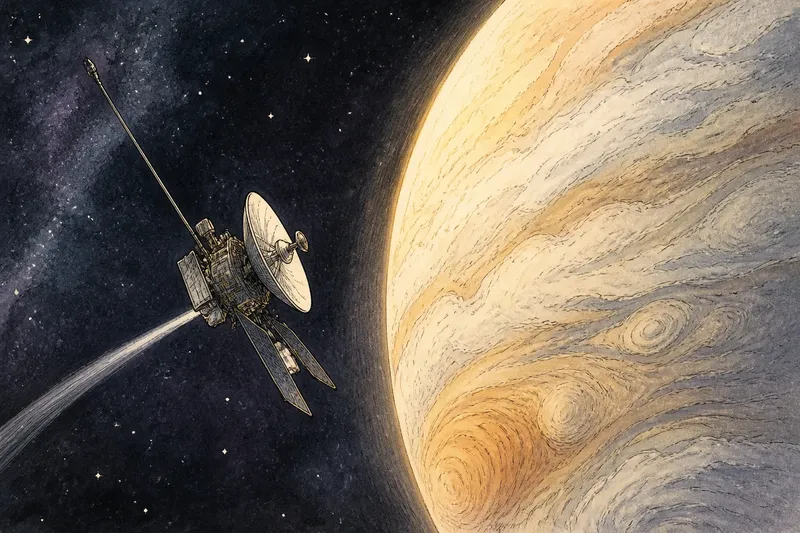
A spacecraft approaches a planet, swings past its bright limb and continues into deep space. Another arrives at the same kind of world and spends years circling it. Flyby or orbit is not simply a choice between a quick visit and a longer one: each route shapes what a mission can observe, how it can travel onward and what questions it can answer.
When a mission description leaves you wondering why a spacecraft did not stop, or why it did not simply fly on, the trouble is often a mismatch between the science goal and the route. A flyby offers a changing, close-up view during a brief encounter. An orbiter repeatedly returns to the planet, building a view across different places and conditions. Neither approach is automatically better; the useful question is what kind of evidence the mission needs.
A flyby trades repeated access for a route onward
During a flyby, a spacecraft passes near a planet without entering a lasting orbit around it. The planet’s gravity bends the spacecraft’s path. Mission planners can use that bend to alter the craft’s direction or speed relative to the Sun, a technique commonly called a gravity assist. The planet is not a fuel station; the encounter transfers motion through the gravitational interaction while the planet’s own change is imperceptibly small.
The encounter is brief because the spacecraft is moving through, not circling. Instruments can observe the planet, its atmosphere, moons or magnetic environment as the viewing geometry changes. That sequence can be especially useful for a first reconnaissance, a survey of several destinations, or a mission whose priority is to reach a more distant target.
The limitation is access. After the spacecraft recedes, it cannot return to inspect a feature from another angle or watch how a storm changes. A close pass can produce a concentrated set of observations, but it cannot offer the repeated, flexible coverage an orbiter provides. A flyby is like looking through a train window: the view changes quickly, and the journey itself carries you elsewhere.
An orbit trades onward momentum for repeated views
An orbiter is placed on a path that keeps it returning around a planet. Rather than racing past once, it can observe multiple regions, revisit locations and collect measurements over an extended mission. The changing orbit and instrument schedule can help scientists compare terrain, atmosphere, seasons or interactions with moons and the solar wind.
That repeated access comes with a demanding arrival. A spacecraft approaching a planet too quickly may need a substantial change in velocity to remain bound by its gravity. This manoeuvre, called orbit insertion, must be planned around the craft’s trajectory, propulsion, communications and the planet’s environment. Some missions use a planet’s atmosphere to slow down, a process known as aerobraking, when the world and spacecraft design make it suitable.
Once in orbit, the spacecraft is not free to look wherever it likes at any moment. Its path determines which regions pass beneath it, while sunlight, instrument limits, data storage and communication opportunities shape the observation plan. An orbiter offers a continuing vantage point, not an unrestricted one. Its route also commits the spacecraft to the planet instead of using that encounter to press on to another destination.
Why does a mission choose a flyby?
A flyby suits a mission that needs a close encounter without making the planet its long-term destination. It can gather useful observations while the spacecraft continues along a route towards another world, or while gravity redirects it onto a more favourable path. The choice is especially compelling when the mission’s questions can be addressed during a single pass.
Why does an orbiter need to slow down?
To stay near a planet, a spacecraft must arrive on a path and at a speed that allow gravity to capture it, or use propulsion to establish a suitable orbit. If it simply crosses the planet’s neighbourhood too quickly, gravity will bend its path but the craft will still depart. The required manoeuvre depends on the destination and mission design rather than on a single rule that applies everywhere.
Can a flyby send a spacecraft towards another planet?
Yes. A carefully arranged flyby can change a spacecraft’s direction and its motion relative to the Sun, helping it travel towards a later target. Mission planners must choose the timing and approach geometry to serve the whole route, so the encounter is one part of a longer trajectory rather than an isolated visit.
Can an orbiter also visit a planet’s moons?
Sometimes, but it depends on the mission’s trajectory and instruments. An orbiter may observe moons during its circuit or be manoeuvred into encounters with them, while changing its path can affect future access to the planet. A mission designed chiefly for the planet does not automatically have the fuel, timing or observation plan for a close tour of every moon.
Match the route to the question being asked
When a mission’s purpose seems unclear, check what it is meant to observe and whether those observations require repeat visits. A flyby can suit broad reconnaissance, a close look at a target on the way past or a gravity-assisted route to another destination. An orbiter can suit questions that need coverage across a planet, changing conditions or repeated measurements from different viewing geometries.
- Look for the main science target. If the mission is mapping a planet or tracking a changing environment, ask how repeated passes help. If it is surveying several destinations, ask how a brief encounter fits the larger route.
- Check whether the craft is described as captured. A planned orbit means the spacecraft is intended to remain near the world; a close approach alone does not mean it will stay.
- Notice the stated role of gravity. A flyby may be planned to redirect the spacecraft, while an orbiter must arrive in a way that permits capture or a deliberate orbit-insertion manoeuvre.
- Look for language about coverage and revisits. Repeated passes point towards an orbital mission, while a sequence of approach, closest passage and departure usually describes a flyby encounter.
- Ask what the route gives up. A flyby gives up later access to gain a continuing journey; an orbiter gives up some onward freedom to keep returning to the planet.
Say a mission is sent to examine a planet’s clouds while also travelling onwards to a distant moon. If its team needs a changing view during the closest approach but not recurring weather observations, a flyby may fit: the craft records its planned sequence, then continues towards the moon. If the question instead concerns how clouds alter across different regions and over time, an orbiter may fit better, because repeated passes provide opportunities to compare observations. These are invented situations, not reports of actual missions; the deciding factor in each is the evidence sought.
Why can an orbital mission still miss a region?
An orbit does not pass over every place at once. The spacecraft’s inclination, altitude and shape of its path determine which areas it can observe, and the ground track may shift as the planet rotates. Some regions may be seen under poor lighting or at an angle that makes a particular measurement less useful. Mission teams balance coverage against other priorities, so “orbiter” means repeated access to a route around the world, not a perfect view of every feature.
Why can a flyby reveal so much in so little time?
During a close approach, the spacecraft’s changing position can give instruments a succession of perspectives and distances. It may observe a broad scene on approach, examine selected features near closest passage and continue collecting data as it departs. That concentrated sequence can be scientifically rich, but it depends on careful timing: the craft cannot pause to repeat a view or adjust its route freely once the encounter is under way.
Read the encounter as part of the whole journey
A mission’s route is often a chain of decisions rather than a single destination choice. A flyby can let a spacecraft use one planet to reshape its path, gather observations and keep going. An orbiter instead spends its arrival effort on remaining near a world, returning for further observations and accepting a narrower onward route.
When you read a mission plan, look beyond the word “visit”. Ask whether the spacecraft must pass through, stay bound to the planet, or use the encounter to change its direction. That distinction makes the mission’s purpose easier to see: flyby or orbit describes not just how long a spacecraft stays, but what kind of journey its designers have chosen to make possible.