How the Moon Became a Destination in Travel Stories
Moon travel stories trace a shift from sky-borne symbol to imagined destination, with clear literary examples to help you read what each journey means.
A child waiting beside a railway platform points at the Moon and asks whether anyone has travelled there. Moon travel stories hold two journeys in that question: the actual voyage made possible by spaceflight and the older literary habit of treating the Moon as a place a traveller might reach.
The Moon served as a landmark before it became a destination
In stories about travel on Earth, the Moon could accompany a character without being somewhere to go. Its changing appearance could mark time, while its light set a scene on a road, a shore or a field. The familiar sight overhead let a writer connect a local journey with a much larger sky.
That use appears in many kinds of writing, but it does not amount to one shared tradition. For a concrete example, the English nursery rhyme “The Man in the Moon” treats the Moon as a figure with a face and a story, rather than as terrain awaiting a traveller. By contrast, the Moon in a poem or folktale may serve as a listener, a source of longing or a sign of change. The meaning depends on the work and its cultural setting.
The distinction matters: a Moon that witnesses a journey is not yet a destination. To make it a place characters could visit, writers had to imagine a route there and decide what a traveller might encounter.
Named works made lunar journeys imaginable
Some writers gave that route a comic or speculative shape long before spaceflight. In the second century, the Greek writer Lucian composed A True Story, a satirical narrative in which a ship is carried into the sky and its travellers reach the Moon. The work uses an impossible voyage to play with claims of travel and marvel; it is not a prediction of a spacecraft journey.
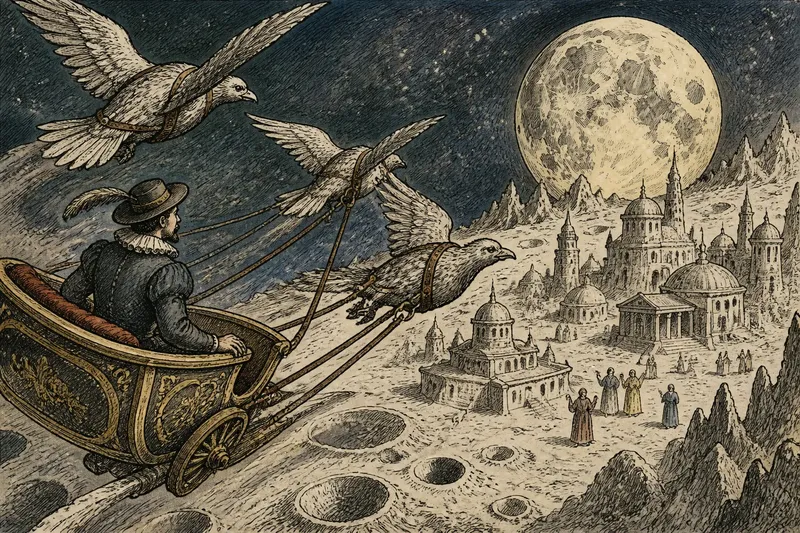
In the seventeenth century, Francis Godwin’s posthumously published The Man in the Moone follows Domingo Gonsales, whose flight is enabled by a team of birds. Its fanciful means of transport and imagined lunar society make the journey a vehicle for speculation about life and customs, not a practical account of reaching the Moon.
These works do not prove that lunar stories changed in one smooth, universal sequence. They do show identifiable ways authors used the Moon: Lucian made it part of satire, while Godwin used it as a setting for an extraordinary voyage and social invention. The historical context and the story’s purpose shape what “travel” means in each case.
Travel conventions made the impossible journey legible
Writers could borrow familiar parts of a voyage—departure, uncertain passage, arrival and return—to help readers follow a journey beyond Earth. The Moon was recognisable from the ground, yet distant enough to stand for the edge of human reach. That contrast made it a useful setting for testing what a traveller might call discovery.
But an earthly journey and a lunar one do not share the same conditions. A traveller on a road can seek shelter, follow a path or ask for directions. A story sending someone beyond Earth must invent the route, the environment and the means of survival. The details of the invented voyage often reveal as much about the author’s concerns as about the destination.
Why do Moon travel stories differ from one another?
Why did writers choose the Moon rather than a star?
The Moon is a distinct, familiar object visible from Earth, so a reader can recognise the destination before knowing anything about its imagined landscape. That combination lets a story begin with a shared sight and then invent what lies beyond it.
What can a fictional lunar society reveal?
It can expose the assumptions a writer brings from Earth, including ideas about custom, power or social order. Read the invented society as part of the work’s argument or satire, not as a description of the real Moon.
Did early authors expect people to reach the Moon?
Not every story was written as a prediction, and works such as Lucian’s A True Story use impossible travel for satire. Check the work’s genre, narrative voice and purpose before treating its voyage as a forecast.
The traveller’s motive shapes the meaning of the voyage
A lunar traveller might appear as a curious guest, a conqueror, a castaway or a representative of a society back on Earth. Each role raises different questions: who has the right to explore, what counts as discovery, and whether an unknown place is treated as a prize or a setting with its own imagined inhabitants.
That is why the vehicle is not always the most revealing detail. A story may dwell on a strange method of flight, yet its deeper interest may lie in rivalry, vanity, fear or the traveller’s expectations. The Moon gives an author distance from familiar institutions while allowing those concerns to remain recognisable.
Read a lunar story by separating observation from invention
Use these checks while reading. For each one, note the evidence in the text; then follow the decision attached to it.
- Check what the narrator says can be seen from Earth. If the detail is an observed feature of the Moon, record it as the story’s starting observation; if it is an assumed feature, mark it as invention and look for what the assumption tells you about the narrator.
- Check how the traveller departs. If the method is described as ordinary travel, ask what familiar voyage the author is adapting; if it depends on magic, satire or impossible machinery, read the departure as part of the work’s imaginative or comic method.
- Check what the traveller expects to find. If the expectation is confirmed, note how the arrival rewards that belief; if it is overturned, mark the change as a test of the traveller’s assumptions.
- Check how imagined inhabitants are described. If they resemble a society on Earth, identify the custom being reflected; if they are presented as wholly unfamiliar, ask whether the story treats difference with curiosity, fear or ridicule.
- Check whether the journey includes a return. If the traveller comes home, note what knowledge or attitude changes; if the story ends away from Earth, consider whether it leaves the traveller’s purpose unresolved.
- Check whether the Moon functions mainly as a setting or a symbol. If events depend on its imagined place and conditions, follow the travel plot; if the Moon mainly prompts longing, change or reflection, read the journey as symbolic rather than literal.
Say you are reading a fictional story in which a traveller departs in a bird-drawn vehicle, expects a society like his own and returns after seeing customs he cannot explain. First, mark the bird-powered flight as an invented means of departure, not a practical travel claim. Next, record the expected social likeness as the traveller’s assumption; then note that the unfamiliar customs unsettle it. Finally, because he returns, compare his first description of home with his last. The resulting interpretation is that the voyage uses an impossible journey to examine the traveller’s expectations about society, rather than to offer a reliable account of the Moon.
Spaceflight changed how readers separate place from symbol
Actual journeys to the Moon gave the imagined destination a new relationship with a real place. Stories could still use the Moon as a symbol, but readers could also distinguish that symbolic work from accounts of a physical journey. The two do not cancel each other: a story can draw on the Moon’s reality while asking what exploration means to people on Earth.
When you read Moon travel stories, look first at what the work asks the destination to do. Is it a landmark accompanying an earthly route, a setting for satire, or a place where a traveller’s assumptions are tested? That question makes the history of Moon travel stories easier to follow without forcing different works into a single timeline.