A Night-Sky Walk with One Constellation in Mind
Plan a relaxed night-sky walk around one recognisable constellation, using nearby star patterns as landmarks without equipment or precise timings.
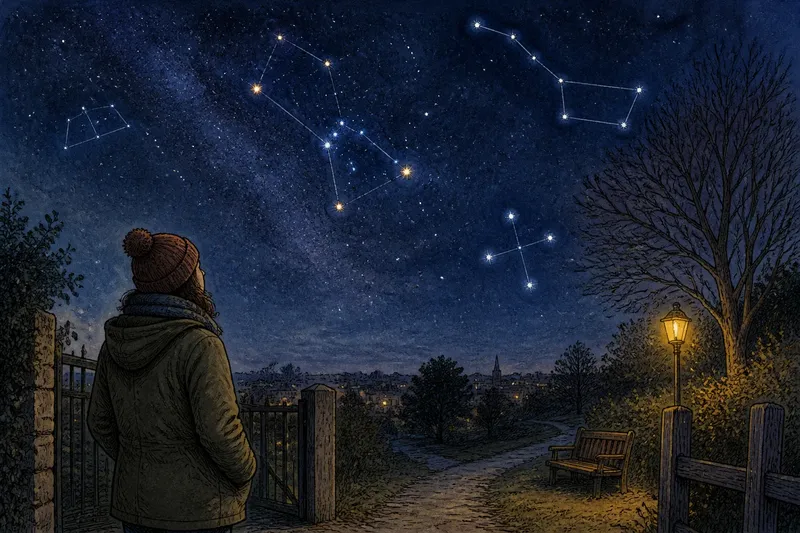
You step outside after supper, pause by the gate and let your eyes settle on the dark. A night-sky walk with one constellation in mind gives the evening a simple thread: find a familiar pattern, then use nearby groups of stars as landmarks rather than trying to identify everything overhead.
Which constellation makes a good starting point?
Choose a pattern that is easy to recognise from where you live and is visible in the season you plan to go. Orion is a useful winter landmark in many northern locations: its three-star belt is a short, distinctive line, with brighter stars nearby forming a larger outline. In other seasons, the Big Dipper, part of Ursa Major, can be a convenient starting shape in much of the Northern Hemisphere. Southern observers might begin with the Southern Cross where it is visible.
These patterns are not equally visible from every place. Your latitude, the time of year and what blocks your view all matter. Before setting out, check a basic seasonal star chart or planetarium app for your location, then select one constellation that should be above the horizon during your outing. The app is preparation, not a tool you need to keep using outside.
Pick a pattern with a clear outline rather than the one with the most impressive name. A few bright stars arranged in a line, cross or recognisable shape are easier to hold in mind than a faint constellation spread across a large patch of sky. If several familiar patterns are visible, choose just one as your anchor.
Where should you go for an easy view?
Look for a place where buildings, trees and bright lamps leave a broad opening above you. A quiet park path, a garden or a safe open space near a familiar route may be enough. You do not need a remote site: reducing nearby glare and finding a view of the relevant part of the sky often matter more than travelling far.
Consider the whole walk, not only the spot where you hope to see stars. Choose a route you know, with a clear way back and surfaces you can judge in the dark. A bench or open patch where you can stand still makes it easier to look up without watching every step at once. If the sky is cloudy or the starting constellation is hidden, treat the outing as a quiet walk rather than a failed observing session.
Check the local forecast and any access notices before leaving. Dress for standing still, take a dim torch if the path calls for one, and keep its beam pointed down when you are not using it. Local access rules and the instructions on any equipment you bring take priority, but no special observing equipment is needed for this plan.
How do you find the constellation without equipment?
Begin with your eyes facing the open sky, not with a search for a tiny point of light. Give your vision a little time to adjust after leaving bright indoor lighting. Then look broadly for the constellation’s overall shape: trace its outline with your gaze before trying to name individual stars.
If you are using Orion, first look for the belt’s compact row of three stars. From there, notice the brighter stars above and below it; their positions help you recognise the larger figure. If you chose another constellation, use the most distinctive feature on your chart—a cross, a dipper-like bowl or a straight run of stars—as your first foothold.
Keep your head and shoulders relaxed. Instead of staring hard at one faint star, look a little to its side; dim points can be easier to notice away from the centre of your gaze. Give yourself permission to be unsure. The aim is to become familiar with a pattern, not to pass a test.
How can neighbouring patterns act as landmarks?
Once you have the main constellation, look beyond its outline for nearby shapes. A bright star, a short line of stars or a broad curve can help you place the constellation in the wider sky. Think of the anchor pattern as a town square and neighbouring star groups as streets leading away from it: the landmarks make the layout easier to remember, even if you do not learn every name.
Choose only one or two nearby features to follow. Find a chart that shows your anchor constellation and its neighbours, then notice what lies above, below or to either side of it. Use those directions as they appear from your own position rather than assuming that the page’s top is the sky’s top; charts can be held in different orientations.
Say you choose Orion on a clear winter evening and can see its belt but are unsure of the rest. You might match the belt to the chart, find the bright stars that outline the constellation, then pick one nearby, easily visible pattern as a second landmark. The expected result is not a memorised map of the whole sky, but a clearer sense of where Orion sits and how you can find it again from the neighbouring shape.
What should you do if the pattern is hard to see?
First, change your position slightly. A tree or roofline may be hiding part of the constellation, and a small move along a familiar path can open the view. Avoid walking while looking overhead; stop in a safe place, look, then move with your gaze back on the path.
If nearby lighting is washing out faint stars, turn away from the lamp or use a spot with a darker view. Do not expect every star on a chart to appear. Charts often include stars too dim for a bright neighbourhood sky, so use the brightest points and the overall arrangement rather than trying to reproduce every mark.
Cloud cover can also break up a pattern. Wait briefly if the cloud is moving, or switch to a visible portion of the sky without losing the evening’s easy pace. If nothing is visible, note what was obscured and try again on another clear evening; choosing a different constellation is an option, not a requirement.
What do people ask before taking a sky walk?
Do I need an astronomy app or binoculars?
No. A simple star chart checked beforehand is enough to choose a constellation, and unaided eyes make it easier to take in the full pattern. Binoculars can wait until you already know where you are looking.
How long should the walk take?
Set aside whatever time suits your route and energy; there is no ideal duration. You can identify one shape, follow a nearby landmark and head home, or linger if the sky is clear and comfortable.
Can I do this from a town or city?
Yes, if you can find a safe place with an open view and some distance from direct lights. Brighter constellations are more forgiving than faint patterns, and a blocked or bright sky may call for a shorter search.
What if I cannot name the neighbouring stars?
You can use them as visual landmarks without learning their names. Notice their arrangement and position relative to your chosen constellation, then use that relationship to orient yourself next time.
How can you make the route feel like a sky walk?
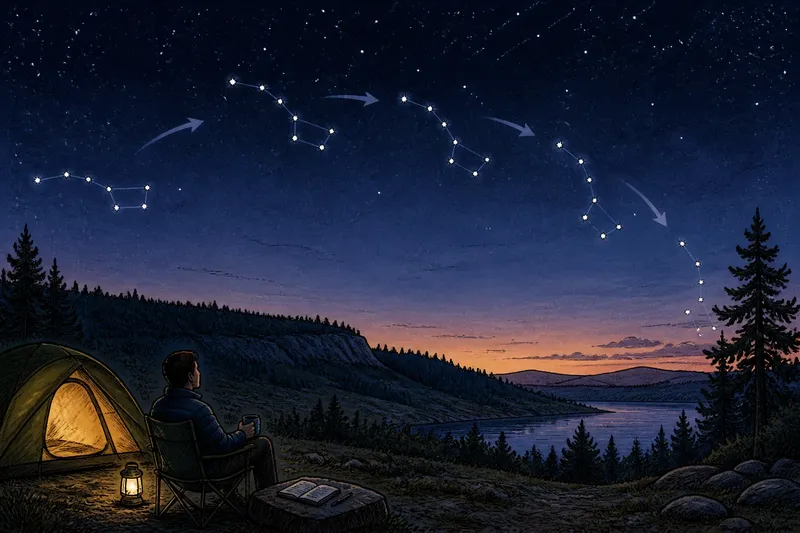
Give the walk a gentle sequence: begin at a familiar place, stop when the constellation is in view, then continue to a second safe stopping point where you can look for its neighbour. Keep the ground route straightforward so your attention can rest on the sky when you are standing still. A companion can take turns describing what each person sees, but matching observations is optional.
If you want to remember the route, write a few plain notes afterwards: where you stood, what part of the constellation you recognised first and which nearby pattern helped. Avoid relying on a photograph to capture the whole scene; a simple sketch of dots and a line can record the relationship more clearly. Use the same starting place on another evening if convenient, but do not expect the view to remain identical as the seasons change.
A night-sky walk with one constellation in mind works best when the destination is modest: recognise one shape and let its neighbours give you a sense of place. Before you leave, look once more at the route under your feet and choose a stopping point for the next clear evening. That small decision turns a passing glance into a sky you know how to return to.